
Jefferson County Previous Residents Sources
Different periods call for different sources. Current parcel data gives the first land key. Landmark carries the online deed trail only to its division-specific cutoff. Printed directories can add named occupants, including people who did not own the land. Census schedules supply household relationships at wide intervals. Sanborn maps describe the structure, not its residents. Early local indexes can carry the search before Birmingham's directory run began.
| Source | Years covered | Where held | What it can show |
|---|---|---|---|
| Landmark Birmingham | Index 1987+; images 1993+ | Probate web and record room | Recorded ownership and title instruments |
| Landmark Bessemer | Index and images 1965+ | Probate web and record room | Bessemer-side recorded chain |
| Birmingham directories | 1883-present, except four nonpublication years | BPL Southern History | Names, addresses, occupations, spouse details by edition |
| Bessemer directories | Selected 1907-1963 volumes | ADAH and BPL inquiry | Separate Bessemer household and business trail |
| Federal census | Named schedules through 1950 | BPL, NARA, FamilySearch | Household, age, birthplace, relationships |
| Sanborn maps | 1885-1950 Birmingham sets | Library of Congress and BPL | Building footprint, materials, and use |
| Early indexed books | Jefferson indexes 1818-1844 | BPL, Probate, ADAH | Deeds, wills, and administrations |
Start with the row nearest the target date, but use at least one other kind of source. A deed can name an owner without naming the family at the house. A directory can name an occupant without proving title. Together, the dated records make a more reliable previous-residents chronology.
Jefferson County Deed Chain
Begin in CAPture with the present street address. Copy the owner, parcel number, situs, and legal description. Open the owner's acquisition deed in Landmark. The seller on that deed is the prior grantor. Search that person as an earlier grantee and match the same lot, block, plat, or metes-and-bounds description. Repeat the role reversal to move back one transfer at a time.
- Fix the current parcel in CAPture and Tax Map.
- Find the current owner's acquisition deed in Landmark.
- Record the grantor, grantee, date, instrument, book and page, and legal description.
- Search the grantor as an earlier grantee, then match the same land.
- At the web cutoff, move to Probate books, grantor-grantee indexes, or archival microfilm.
- Grantor
- The party transferring an interest in the land.
- Grantee
- The party receiving that interest.
- Chain of title
- The linked sequence of recorded transfers for the same land.
- Legal description
- The lot, block, plat, or boundary text that can survive a street-name or number change.
The Probate Recording search and copy guidance is shown below.
It confirms the counter and mail fallback that becomes vital when the online index ends.
Jefferson County Division Cutoffs
Jefferson County's Birmingham and Bessemer divisions create two different online boundaries. Birmingham's Landmark index begins in 1987 and its images in 1993. Bessemer index and images begin in 1965. These dates measure online access, not record survival. Probate's archive description says older Birmingham land, map, and marriage records reach the 1800s, while Bessemer records reach back to 1915.
Before those dates, use the appropriate Probate record room, deed books, grantor-grantee indexes, and ADAH or FamilySearch microfilm. A mail request should include buyer and seller names when known, the sale date, and the party or property address. Staff can copy a record but will not perform a title search. That limit makes a well-built chain sheet useful: one line per transfer, with roles, dates, land text, and unresolved conflicts.
The official Probate recording-cost page appears below.
Recording charges concern filing new instruments. For existing record-room copies, the research reports $1 per page, $15 per plat page, and $2 more per certified document.
Note: The Birmingham or Bessemer cutoff changes the next access channel, not the underlying identity of the land.
Jefferson County Previous Residents Directories
Owners are only half of a house history. A city or street section may name occupants who never appear in the deed chain. Birmingham Public Library holds Birmingham directories from 1883 to the present, but none were published in 1933, 1936, 1943, or 1945. The Alabama Department of Archives and History lists a broad Birmingham, suburban, and Jefferson County Metropolitan run, plus selected Bessemer editions from 1907 through 1963.
Select a known year and address. Check the alphabetical entry and any street or householder section available in that volume. Copy the spelling, spouse, occupation, business address, home address, and notation exactly. Then repeat in adjacent years. Do not import an abbreviation meaning from another edition. The full holdings and reading method belong to the Jefferson County city directory collections, while the past-residents task is to place each name on the address timeline.
- Bracket the target year with the closest available directory editions.
- Pair a directory name with the 1940 or 1950 census when the date fits.
- Use BPL old and new street-name lists when the address text shifts.
- Check obituary, probate, and cemetery indexes for a household trail that ends.
- Record nonpublication and missing pages as gaps, never as a move.
Directories, deeds, and census schedules provide different time slices of the same address. That contrast is valuable. It can distinguish a prior owner from a later occupant and prevent a skipped book from becoming an invented departure date.
Note: Treat 1933, 1936, 1943, and 1945 as Birmingham directory gaps, not as proof that an occupant moved.
Map Past Jefferson County Homes
Sanborn fire-insurance maps add the building behind the name. Library of Congress coverage includes Birmingham sets from 1885, 1888, 1891, 1902, 1911, and 1930, with an updated volume reaching July 1950 and including Irondale and Trussville material. A map sheet can show footprint, construction, use, and fire hazards. It does not name the previous residents.
Match a Sanborn sheet to a same-era directory or deed. First use the volume's key map. Then compare street names, block shape, lot position, and nearby landmarks. If the number changed, keep the old address in the notes and use the legal description or plat to anchor the parcel. A new footprint between editions may explain a permit or a directory gap without proving that a household moved.
For broader archival context, the Alabama Department of Archives and History research gateway is captured below.

The gateway helps locate state catalogs and microfilm that can extend a Jefferson County address trail beyond local web coverage.
Jefferson County Archive Fallbacks
The Birmingham Public Library Southern History Department is the central local fallback. Its collections include directories, census material, newspapers, obituary indexes, maps, cemetery and church databases, rare books, clipping files, and licensed databases. The room at Linn-Henley Research Library is open Monday through Saturday from 9 a.m. to 6 p.m. Books and periodicals generally stay onsite, while copying or overhead scanning depends on condition. The official BPL Archives and Manuscripts page is shown below.
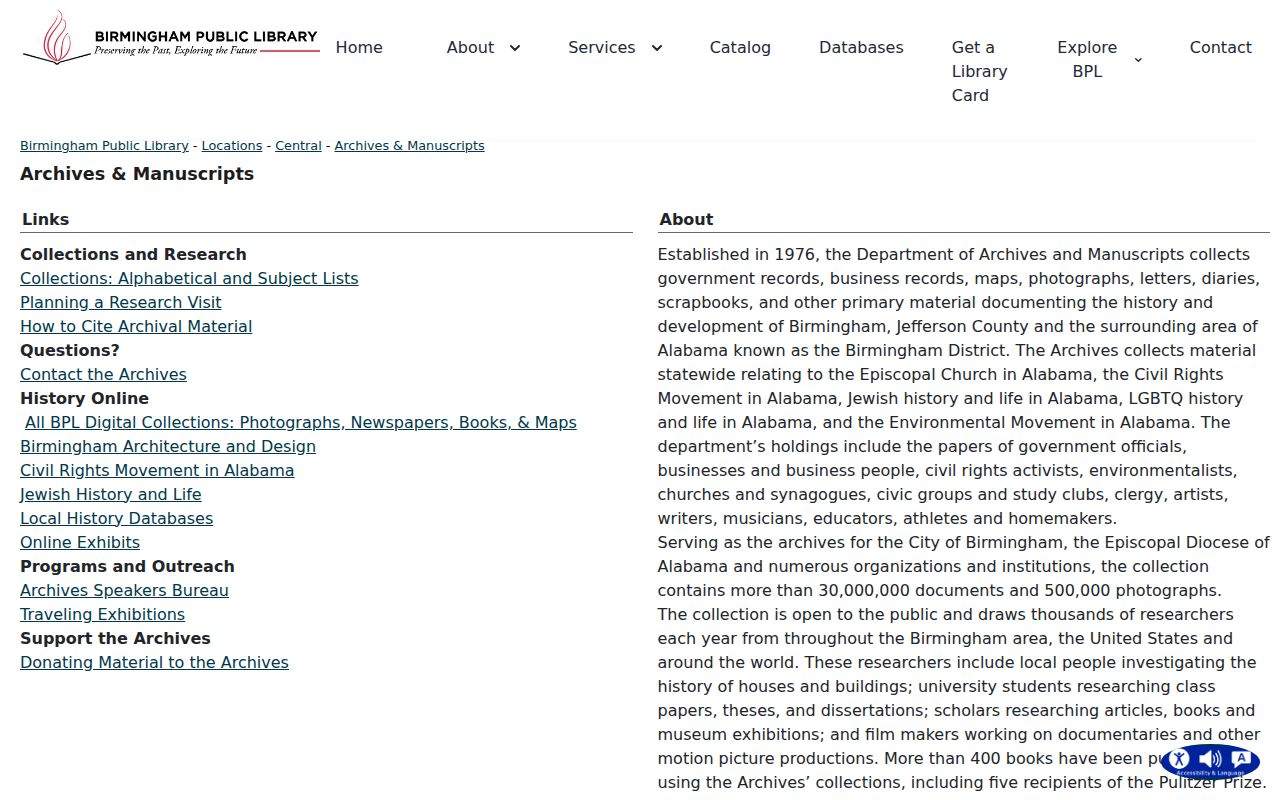
BPL Archives began in 1976. Its civil-rights holdings now exceed one million documents, and its city-record work can add photographs, files, and local context to an address timeline. A specific written Southern History request normally receives an answer within 48 hours. The stated research fee is $5. Delivery may be an emailed PDF or copies at $0.30 per page plus postage, with a prepaid limit of 20 pages. Staff does not conduct extensive research or census and military microfilm searches, so supply names, an exact address, a narrow year range, and the desired title. For a defined state-level question, use the ADAH research-request service shown next.
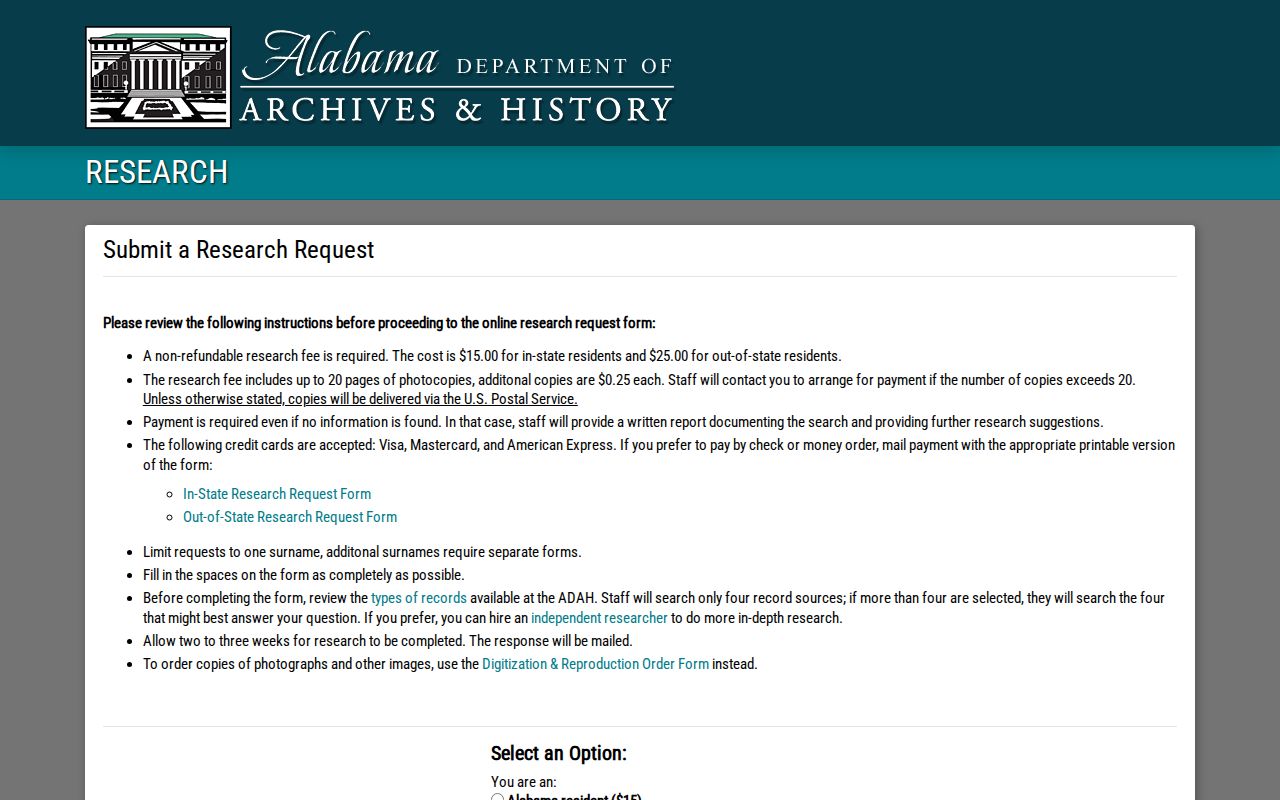
Use it for a defined Jefferson County record or microfilm question after catalog work identifies the likely series.
Jefferson County Address Pivots
Address history can break a sound name search. Birmingham was chartered in 1871, and the county seat moved there in 1873. The county took over postal addressing in 1978, adopted numbering and street-name rules in 1982, and completed rural route and box conversion by 1994. Annexation, a changed direction or suffix, and a later postal city can all separate today's search text from an older directory entry.
Do not silently modernize an old address. Preserve the form printed in each source. Bridge it with the parcel number, subdivision, lot, block, plat page, Sanborn key, and BPL old/new street aids. A current Birmingham mailing label may cover land outside Birmingham, while the Bessemer division is not defined by ZIP. The land description is the best constant when names and numbers move. The UAB Special Collections gateway is another archival source for Jefferson County previous-residents work.
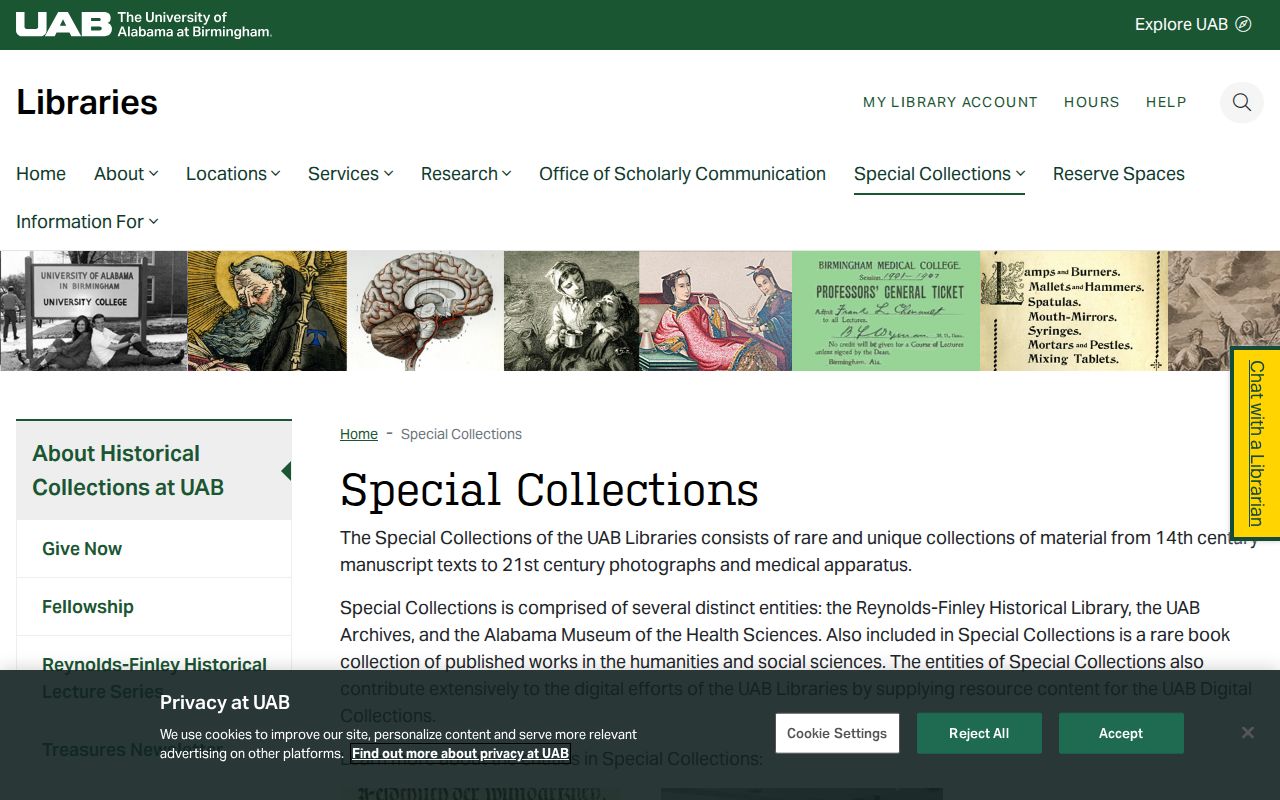
Check its catalog for address-specific institutional or local material, while keeping official ownership claims tied to Probate and tax records.
Note: Preserve each historic address exactly as printed before adding a modern parcel match in a separate field.
Jefferson County Previous Residents Limits
Previous residents are not the same as previous owners. A deed chain follows recorded land interests. A directory may add a spouse, boarder, worker, or business. Census schedules describe a household at one enumeration. An obituary can identify relatives, and a public probate estate may name a representative or heirs. None of those facts proves where a living relative now resides.
Jefferson County's 1870 courthouse destruction also warns against treating a gap as loss of the whole record. Early BPL indexes for deeds, wills, and administrations from 1818 through 1844 show that material survived. Test each series with Probate, BPL, and ADAH. Similarly, the four directory nonpublication years are not evidence that a family left.
Lawful use. Research past Jefferson County households for genealogy, estate work, historic preservation, and personal curiosity. Do not use a past address to track, expose, threaten, or harass a living person.
A defensible result states the role and date beside every name. It flags estimated links, spelling variants, and missing editions. When deeds, a directory, and a census align on the same land and period, the previous-residents trail is strong. When they conflict, preserve both readings and return to the original record rather than forcing a tidy story.